
Journaling on Paper vs. an App: Honest Trade-offs and How to Choose
A notebook and pen, or the phone already in your hand — both are good journaling tools. An honest comparison, three axes for choosing (writing friction, review, privacy), and how Emopi Diary answers each.
Emopi Editorial Team
The first fork in the road after deciding to journal is the tool. A favorite notebook and a good pen — or the phone that is already in your hand. Neither is the right answer for everyone; the useful question is where you personally tend to stumble.
This article compares paper and apps honestly, then offers three axes for choosing.
What each does well
| Paper notebook | App | |
|---|---|---|
| The act of writing | The feel of the pen and the physical act of writing | Write the moment a thought arrives, anywhere |
| Keeping the habit | Strong once the notebook-opening ritual takes hold | Visible records and gentle reminders carry the habit |
| Looking back | The pleasure of turning pages — but no search | Search, calendars, and charts make review fast |
| Privacy | Physically hideable — but readable in full if found | Locks and encryption, if you choose an app that has them |
| Portability | The notebook has to come along | The phone is already there |
In short: paper wins on the richness of writing; apps win on the strength of the record and on lightness.
The often-cited handwriting experiment tested lecture note-taking and later quiz performance (Mueller & Oppenheimer, 2014). A direct replication of one study did not support a longhand advantage in immediate learning (Urry et al., 2021). Neither tested journaling or mental health, so neither settles which tool is better for that purpose. We suggest choosing by ease of writing, storage, and review.
Three axes for choosing
Axis 1: How low does the writing friction go?
If writing feels like a chore, look at the effort required to start. For paper: can “open and write one line” stay light? For an app: how many taps from launch to writing, and does it demand composed prose? Judge by whether your most exhausted self would still use it.
Axis 2: Does the record invite looking back?
Written-and-forgotten is half the value. Will you notice, weeks later, “so that’s the pattern lately”? For paper, that means a rereading ritual you will actually keep; for an app, a review screen you actually want to open.
Axis 3: Can you write the honest version safely?
Journaling matters most when it is honest, and honesty needs the confidence that no one else will read it. For apps, look past the lock screen and check how the stored data itself is protected.
How Emopi Diary fits
If you want to write briefly on your phone and return to entries by date or topic, Emopi Diary is one option. Here is how it works along the three axes above.
Friction: start with one line
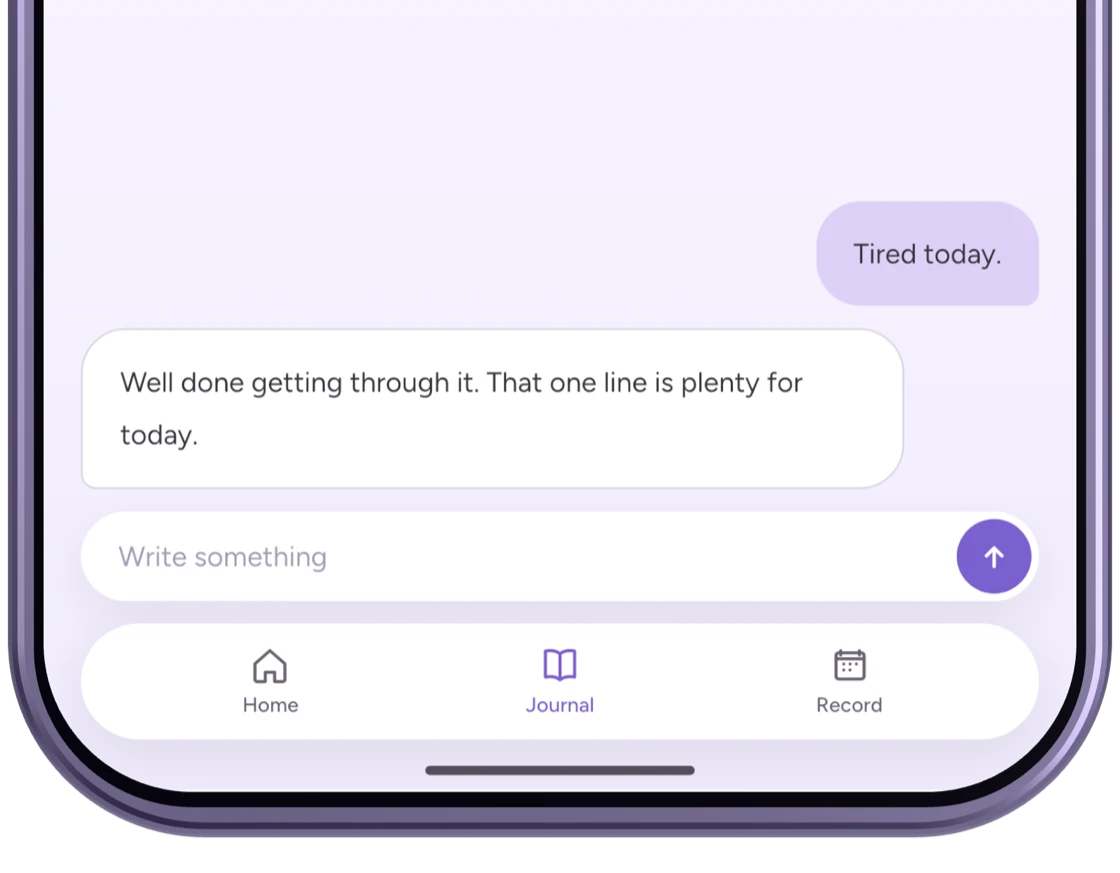
You can send just “Tired today.” in the Journal tab. Within your usage allowance, the AI replies and gathers your notes into an entry. If nothing else comes to mind, you can stop at that line.
Images marked “Actual app UI” use fictional test data; other figures are illustrative recreations. Displayed content and AI replies are examples. Screens may vary by version.
Review: find entries through a topic tag
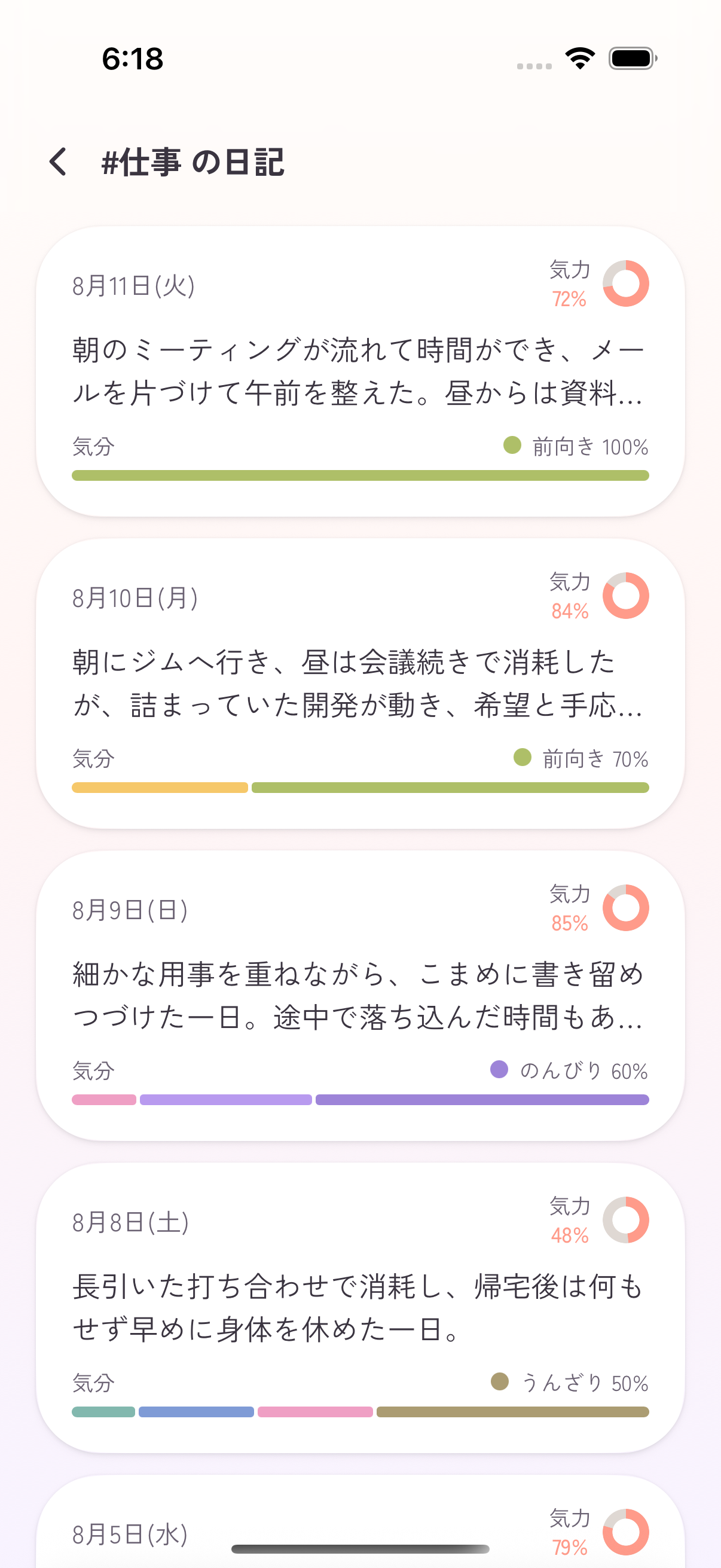
When did you write about work? You do not need to remember the date: tap a topic tag on a journal summary to open entries carrying that tag. “Work,” for example, brings together entries about days of meetings or progress on a project.
Tag filtering covers the latest three days on Free and all dates on Diary Plus. This is a limit on the filtered list; older journal text and the tags on individual entries remain readable.
Honesty: check how your data is handled
Journal text — notes and summaries — is encrypted before storage with a dedicated key managed separately from the database. This is encryption at rest, not end-to-end encryption. The privacy and data protection page also explains what data is sent to AI.
You can also use both
One more option: skip the either/or. Keep the daily record light in an app, and once a month, write a reflection in the notebook you love. The richness of paper plus the strength of a digital record — a combination that holds up well in practice.
Wrapping up
- Paper wins the writing experience; apps win the record. Both are right answers.
- Choose by: whether your tired self would use it, whether the record invites review, and whether honesty is safe there.
- Emopi Diary answers with one-line notes, built-in review, and encrypted journal text. For keeping the habit itself, see our guide to keeping a journal going.
Related articles


Emopi Diary
A journal you write with AI
Jot down a few words whenever something comes to mind, and AI shapes them into today’s entry — with mood, energy, and topic tags added automatically. Coming soon to iOS / Android.