
Bedtime Journaling: Settle the Day Before You Sleep
Mind racing the moment your head hits the pillow? Explore a short writing routine, what a sleep study did and did not establish, and a three-line example in Emopi Diary.
Emopi Editorial Team
The moment you get into bed, today’s conversations and tomorrow’s schedule start replaying. The body is tired; only the head stays awake — everyone knows nights like this.
Bedtime journaling means briefly recording the day or thoughts you want to put down before sleep. This guide separates a study of bedtime writing from our suggested three-line routine.
Why write before bed?
- The day is fresh in memory. Evening can be a convenient cue if you have time then. Morning or midday is equally valid if it suits you better.
- You can record upcoming tasks. In a one-night laboratory study of 57 healthy young adults, participants writing a to-do list for five minutes fell asleep about nine minutes sooner on average than those listing completed tasks (Scullin et al., 2018). There was no no-writing group. The study did not test bedtime journaling generally, the three-line routine below, or Emopi Diary.
- You can give writing an endpoint. Write briefly, then close the notebook or app as part of your evening routine.
The three-line bedtime format
This is our suggestion for keeping writing brief, not a tested sleep intervention.
- One line for what happened. “Meetings all day.” “Finally took a walk.” Facts are enough.
- One line for how you feel. “Honestly, drained.” “All told, not a bad day.” This doubles as naming practice — see our guide to putting feelings into words.
- One line for tomorrow’s you. “Start with that reply.” “Going to bed early — well done.” The lingering “I have to remember to…” gets written down and set down.
Three lines, close the page, done. Try keeping it to around five minutes.
A few cautions
- Keep it from becoming a self-review. If writing turns into harsh self-judgment, stop for the night. Placing short facts and feelings beats listing what went undone — that is what keeps evening writing sustainable.
- Move reflection to another time if it wakes you up. The study does not establish that writing about the past harms sleep. If reflection feels burdensome at night, keep to a task list or try another time of day.
- Keep screen time short. Five minutes of writing, then toward sleep.
- Persistent sleep problems belong with a professional. Journaling is one way to tidy the runway to sleep, not a treatment for insomnia. If hard nights persist, please talk to a clinician.
If you use Emopi Diary for a short bedtime note
If you choose your phone for bedtime writing, you can try the three-line format in Emopi Diary. Paper is also an option if the screen keeps you engaged for longer than you intended.
“Meetings all day.” “I was a bit on edge.” “Tomorrow starts with that reply.” Leave one short note for the event, the feeling, and tomorrow’s task. Keep it shorter or skip it if you have no energy to write.
Figures are illustrative recreations. Displayed content and AI replies are examples; actual screens and outputs may differ.
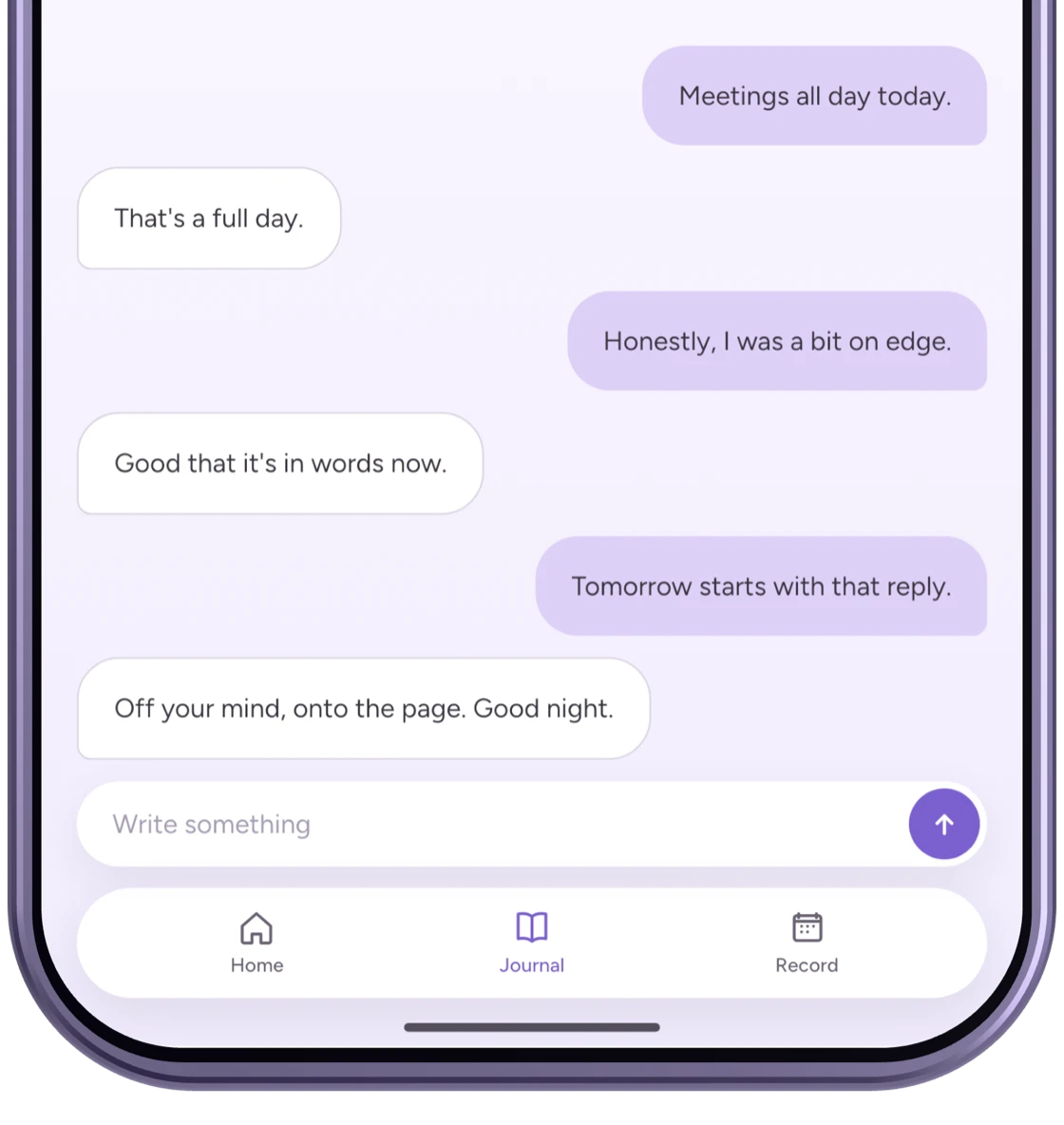
You can close the app when you finish writing. There is no need to wait for the AI summary or review charts that night. If you want to reread, return another day when you have time.
Wrapping up
- Bedtime journaling writes out the head’s leftover loops before sleep — one laboratory night found faster sleep onset after listing upcoming tasks than after listing completed tasks. It was not a comparison with no writing.
- Three lines suffice: what happened, how you feel, one word to tomorrow. Keep it from turning into a self-review.
- In Emopi Diary, three evening notes become the day’s entry on their own. For making it stick, see our guide to keeping a journal going.
Related articles


Emopi Diary
A journal you write with AI
Jot down a few words whenever something comes to mind, and AI shapes them into today’s entry — with mood, energy, and topic tags added automatically. Coming soon to iOS / Android.