
How to Express Your Feelings to Your Partner When Words Are Hard
You have something to say, but it will not come out. Try putting "writing" before "talking": this guide unpacks why feelings are hard to voice, how to sort them out on paper first, and how a sense of how you are doing can reach your partner in Emopi — without handing over the words.
Emopi Editorial Team
There is something you want to say — but face to face, it will not come out. You catch yourself hoping they will just notice, then feel a little deflated for hoping that. The longer two people are together, the harder expressing feelings can quietly become.
This article unpacks why feelings are hard to put into words, then walks through an approach to try: putting “writing” before “talking.” At the end, we show how Emopi turns that into an everyday shape.
Three reasons feelings are hard to voice
Several things can make it difficult to express a feeling:
- The feeling itself is not sorted yet. Starting a conversation at the “something feels off” stage means searching for words mid-sentence, which is how unintended phrasings happen.
- Timing is hard. The right moment depends on their mood and the room. Repeat “maybe not now” enough times and the feeling just accumulates.
- The reaction is scary. What if it lands too heavy? What if it gets brushed off? The more you think about it, the deeper the words retreat.
Sometimes these difficulties overlap with trying to sort the feeling out and hand it over in a single motion. Trying them separately may make the task feel smaller.
Write before you talk
Before talking, write it out — for your eyes only.
- Separate facts from feelings. “They came home late (fact).” “I felt worried and lonely (feeling).” In Study 2 of two diary studies of college students’ everyday interactions, emotional disclosure was more strongly associated with intimacy felt in that interaction than factual disclosure (Laurenceau et al., 1998). These were not exclusively romantic couples, and disclosure did not guarantee closeness.
- Try a nearby feeling word. Consider “lonely,” “anxious,” or “frustrated.” If none fits, “I cannot quite name it yet” is a valid note too.
- Write as if your partner will not read it. Try writing a version you do not need to prepare for anyone else. Deciding what to share and what you have already digested comes afterward.
For a fuller how-to, see our guide to putting feelings into words.
Small adjustments when you hand it over
Once sorted, the handover only needs small touches.
- Lead with “I.” Not “you’re always late” but “I felt a little lonely.” Try describing your own experience without assigning blame.
- Hand it over small. Try raising one concrete point at a time. Agree together on when a longer conversation is needed.
- Keep a channel besides talking. If saying it out loud is hard, writing counts. What matters is that it arrives — not which road it takes.
For example: “I was worried when I did not hear from you yesterday. Could you send a short note when you will be late?” That names the event, the feeling, and a request. If speaking up feels unsafe, prioritize your safety and support from someone you trust.
How Emopi works — you write for yourself; your status reaches them
Sharing requires an active connection and enabled sharing settings. Your journal text and AI summary stay private; the app does not automatically know how you feel on days without a record.
Emopi turns “sort it out in writing, then let it reach them” into a daily shape.
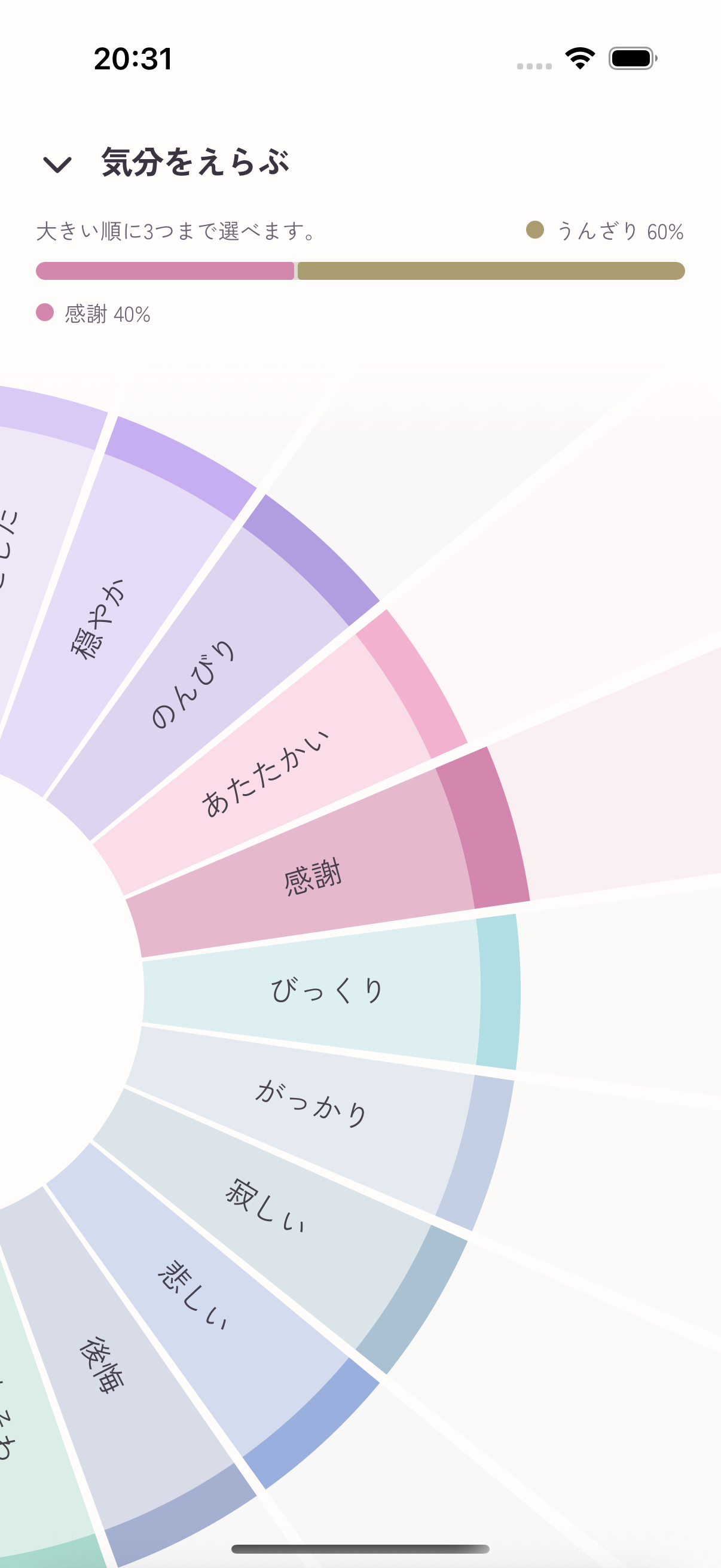
Put a name on the feeling
The AI suggests mood labels to each journal entry, and you can adjust it yourself — picking from a wheel of feeling words. Choosing today’s mix is itself a naming exercise.
Images marked “Actual app UI” use fictional test data; other figures are illustrative recreations. Displayed content and AI replies are examples. Screens may vary by version.
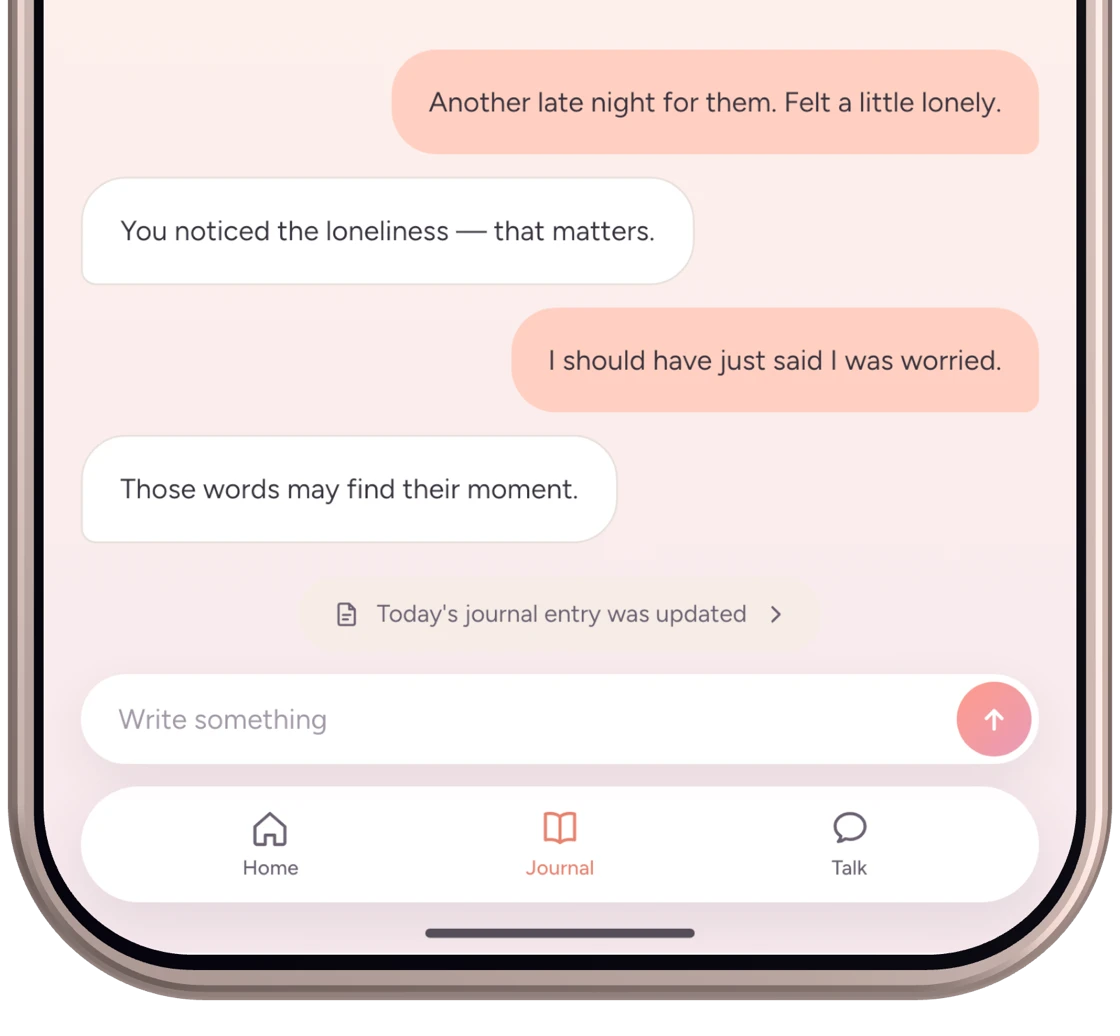
You write for yourself; you choose which status items to share
Journaling in Emopi is just jotting a few words. The AI gathers them into today’s entry, and only your mood and energy reach your partner as a sense of how you are doing. The honest sorting stays yours; what is shared is only the range you chose.
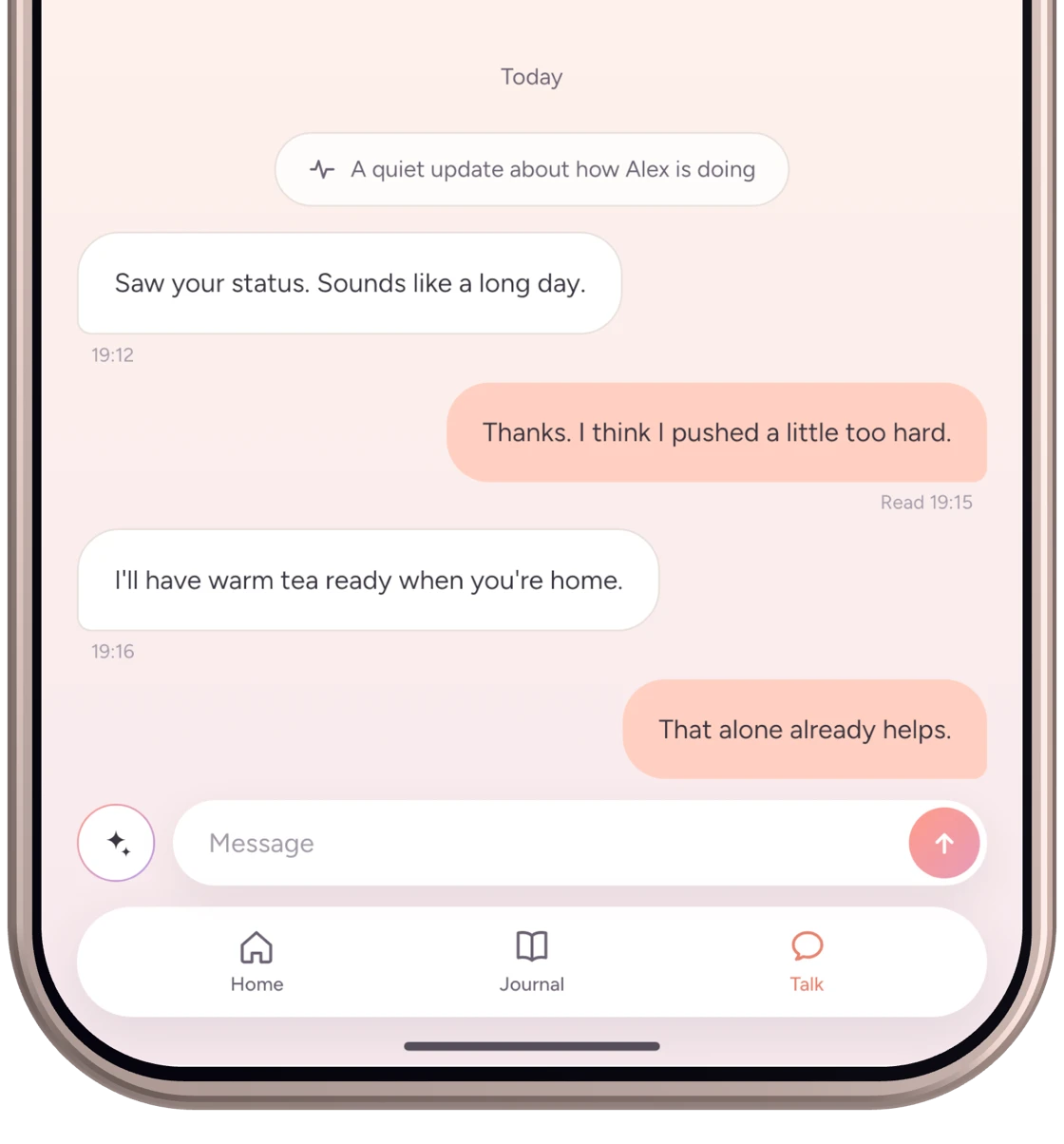
When you want words, there’s Talk
Talk lets you add words to a shared status. For example: “Today was hectic — I’d love a quiet evening.” The app cannot tell your partner what you want without you saying it.
When you want to review the wording before sending
Emopi Plus offers wording suggestions before you send. Open “Get wording suggestions” in Talk and write your draft. Tap “Soften this”; when a useful rewording is available, the app shows options. Choosing one returns it to the input field. Check that it matches your intent, edit if needed, then send. Choosing an option does not send it to your partner.
Use this to review your own words. You decide what you want to say. Suggestions require consent to AI processing and available AI usage. The pricing guide explains who can use Plus features.
Wrapping up
- If feelings are hard to voice, try separating the time for sorting them out from the time for sharing them.
- Write for yourself first: split facts from feelings, and give the feeling a name.
- Hand it over with “I” as the subject, in small pieces — writing counts as a channel too.
- Emopi makes “sorted in writing, shared to the extent you choose” an everyday rhythm. See also our guide to journal apps for couples.
Related articles


Emopi
Share how you feel with the people you care about
Jot down a few words, and Emopi gathers them into a journal. Connect with someone you care about to share how you’re doing. Coming soon to iOS / Android.