
When Couples Stop Talking: What to Try Before Forcing More Conversation
Fading conversation alone does not tell you where a relationship stands. This guide unpacks the ordinary mechanics behind it, three things to set up before trying to talk more, and how Emopi keeps a sense of each other flowing.
Emopi Editorial Team
At some point, the exchanges became mostly logistics. You sit in the same room, each on your own phone, and the day ends. “We don’t really talk anymore” is rarely a sudden event — it advances quietly, a little at a time.
One important thing first: fading conversation alone does not determine where the two of you stand. Practical constraints and feelings can both play a part. This article looks at those ordinary mechanics, then at what you can set up before pushing yourselves to “talk more.”
And if distress has been persistent, or the situation does not feel safe, please reach for a trusted person or a professional support service before any of the tips here.
The very ordinary mechanics of fading conversation
- Rhythms drift apart. Different homecoming times, different bedtimes — the window for a relaxed conversation simply stops overlapping.
- No energy left. When work and the household spend the day’s energy, the wish to talk survives but the strength to word it does not.
- Topics drift toward logistics. Messaging apps handle the practical stuff, so non-practical topics — “how was your day, really?” — quietly lose their slot.
Practical constraints can play a part, and so can unresolved hurt or differences in expectations. Start by finding out what feels difficult for each of you.
Three things to set up before “talking more”
1. A way to know how they are doing right now
What hurts most about less conversation is not the silence itself — it is losing track of how the other is doing. Tired or at ease? Just knowing that lets you judge “I’ll keep tonight quiet” or “now seems like a good time.”
Psychologists call feeling understood, cared for, and appreciated perceived partner responsiveness. A diary study of married partners linked disclosure and perceived responsiveness to intimacy that day (Laurenceau et al., 2005). It did not establish that quality beats quantity or that an app improves a relationship; it offers a reason to consider how each person feels heard.
2. Asynchronous sharing as a routine
If sitting down at the same table at the same time is hard, switch to sharing that travels across time: write at your own pace, read at theirs. Agree on expectations, such as “tomorrow is fine for a reply,” so a delayed response does not have to become a guessing game.
3. A channel besides talking
A short note or an agreed way of sharing mood can help with timing. For example: “I am tired tonight. Could we talk after dinner tomorrow?” That shares both the present need and a time to return to the conversation.
What Emopi offers before a conversation
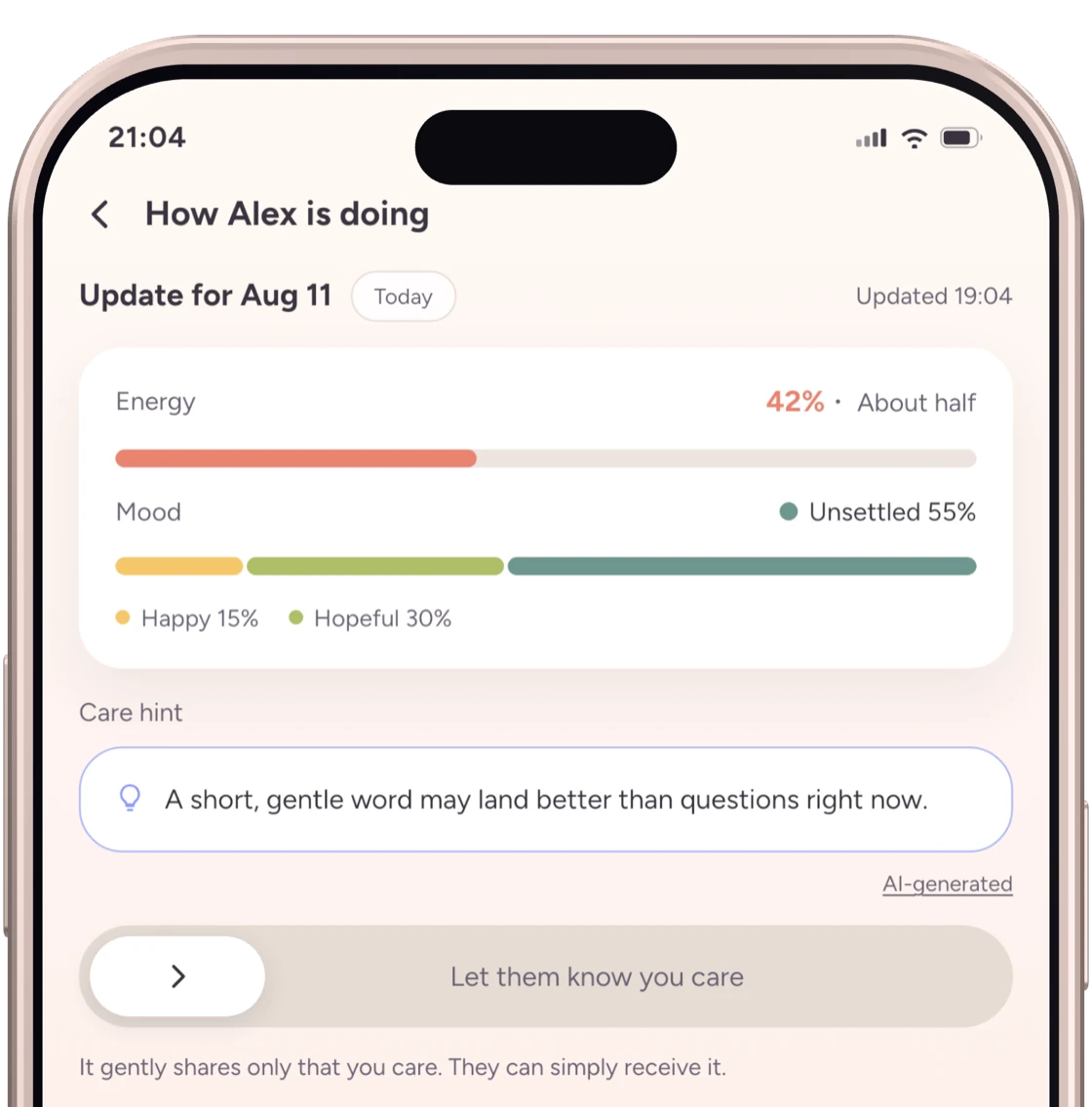
In Emopi, you can see the mood and energy your partner shares and send a small “thinking of you” signal. It is one way to check in when there is little energy for a long conversation.
See the status they choose to share
Sharing requires an active connection and enabled sharing settings. Your journal text and AI summary stay private; the app does not automatically know how you feel on days without a record.
When you jot notes, the AI gathers them into an entry and suggests mood and energy. The items you share appear as bars on your partner’s screen. Care hints are also available when either person has Emopi Plus and mood, energy, and hint sharing are enabled.
Figures are illustrative recreations. Displayed content and AI replies are examples; actual screens and outputs may differ.
Send “thinking of you” without starting a conversation
Slide “Let them know you care” on their status screen to send the signal. They can simply receive it, or choose a short reply: “Pretty good,” “Okay,” or “Not great.”
Agreeing that a reply is optional keeps this check-in from becoming another obligation. When there is something specific to say, add your words in Talk or a usual conversation.
A status or an AI hint cannot tell you their wishes. You can ask, “Would you like me to listen, or would you prefer a quiet evening?” Check the sharing guide for the privacy controls.
Wrapping up
- Practical constraints and feelings can both affect conversation. Ask what is difficult for each person rather than assuming a cause. When distress persists, professional support services are a real option.
- Before talking more, set up: a way to know how they are, asynchronous sharing, and a channel besides talking.
- Emopi keeps a sense of each other flowing from nothing more than your own journaling. See also sharing across distance and how to express your feelings.
Related articles


Emopi
Share how you feel with the people you care about
Jot down a few words, and Emopi gathers them into a journal. Connect with someone you care about to share how you’re doing. Coming soon to iOS / Android.